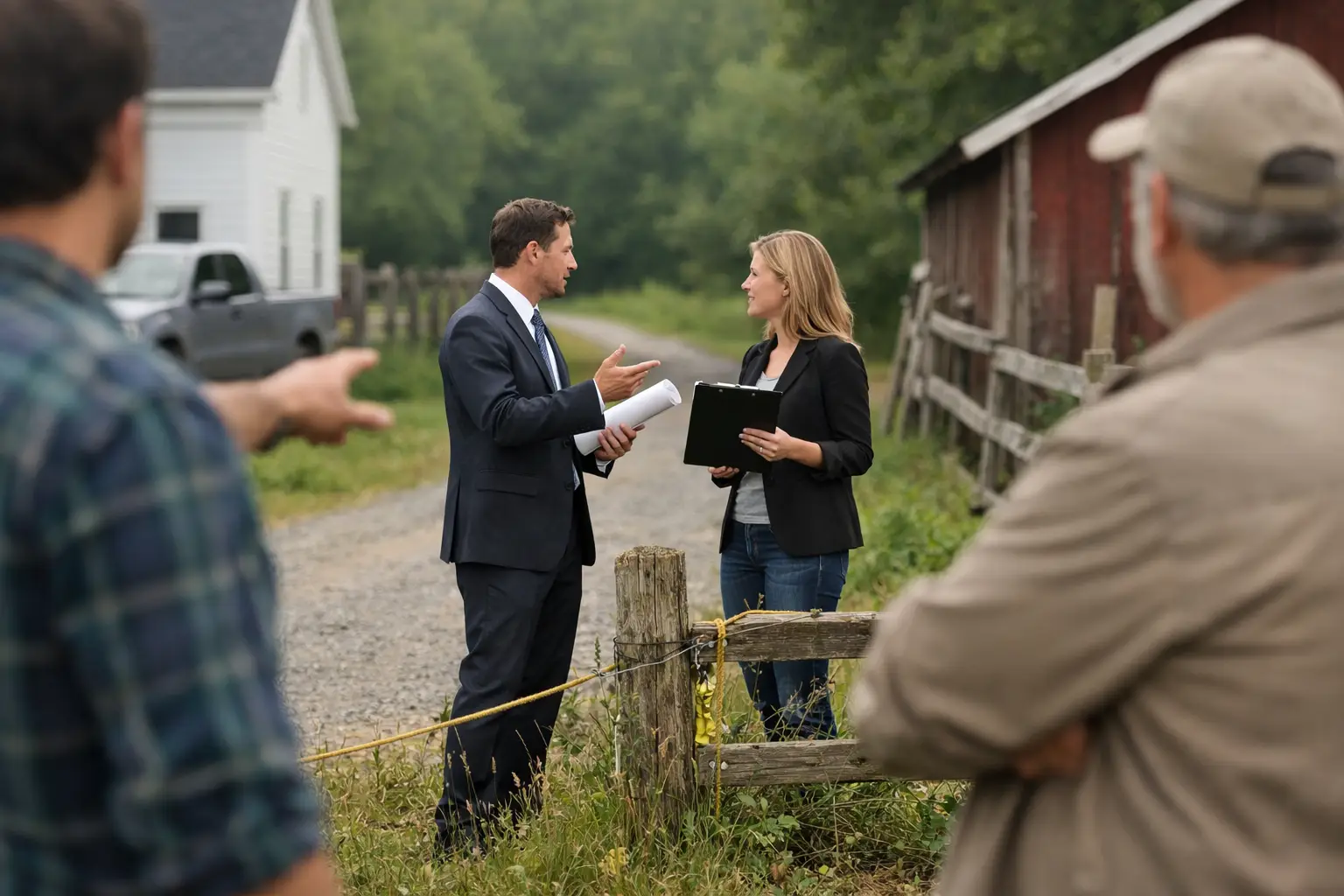
A fence post placed two feet too far to the east can turn a quiet property line into a serious access problem. This easement dispute example shows why owners should address a blocked driveway, disputed lane, or unexpected use of their land before the conflict affects a sale, financing, neighbor relationships, or daily access to a home or business.
Easement disputes are rarely just about a strip of ground. They concern the right to use that ground, who carries maintenance responsibilities, whether the use has expanded, and what the recorded documents actually permit. The answer may be found in a deed, plat, survey, long-standing use, or a court order. Assumptions, even reasonable ones, are not a substitute for a clear legal review.
An Easement Dispute Example: A Shared Access Road
Assume that two rural properties share a gravel road. The road crosses the front corner of Parcel A before reaching Parcel B, which otherwise has no practical connection to a public road. Years ago, the owner of Parcel A signed and recorded a deed granting Parcel B a 20-foot easement for ingress and egress.
For years, both households use the road without conflict. The owners of Parcel B drive personal vehicles over it, contribute occasionally to gravel costs, and accept that Parcel A keeps a gate near the road entrance. Then Parcel B is sold to a buyer who operates a landscaping business from the property. Large trucks begin using the road several times a day. The new owner widens portions of the lane, cuts back trees along its edges, and asks Parcel A to leave the gate open at all times.
The owner of Parcel A objects. They install a locked gate, arguing that the business traffic is damaging the road and that the easement was intended only for a residence. The owner of Parcel B argues that the recorded easement gives unrestricted access and that a locked gate prevents reasonable use.
Neither side should rely on a quick reading of the phrase ingress and egress. The specific deed language matters, but so do the surrounding facts. A court may consider the easement's stated width and location, the purpose disclosed in the grant, the nature of historical use, the burden imposed on Parcel A, and whether the gate creates an unreasonable interference with Parcel B's access. The result can depend on facts that appear minor at the start of a disagreement.
What the Documents May Reveal
The first question is usually not who has been the most accommodating neighbor. It is what right was created and where it exists. An express easement is commonly created by a written instrument, such as a deed, that should be recorded in the county land records. It may identify a fixed route, specify its width, state allowed purposes, or assign duties for repairs and maintenance.
In the example, a 20-foot access easement does not automatically permit the holder to use 40 feet, move the route for convenience, or remove vegetation outside the easement area. On the other hand, an easement for access does not necessarily prohibit reasonable modern use simply because vehicles are larger or traffic patterns have changed. The language and the original purpose must be evaluated in context.
A title review may uncover related documents that change the analysis. A subdivision plat may show utility or drainage easements. A later deed may reserve rights that a prior deed did not. Restrictive covenants may limit commercial activity even if access is technically available. A current survey can also reveal a basic but consequential problem: the road may not be located where everyone believed it was.
Property owners should gather the recorded deed, legal description, survey, title commitment or title policy, photographs, correspondence, and any agreements concerning gates or repairs. These materials help an attorney identify the issue before positions harden around incomplete information.
Not Every Easement Is Written Down
Some disputes involve rights that are not clearly stated in a recorded grant. Depending on the facts and applicable state law, a party may claim an easement by necessity, implication, prescription, or long-standing use. These claims are highly fact-specific.
For example, an easement by necessity may arise when land is divided in a way that leaves one tract without access to a public road. A prescriptive easement claim can involve open, continuous use of another's property for the legally required period under circumstances recognized by state law. It is not enough for someone to say, “We have always used that road.” The character of the use, permission given by the owner, duration, and other facts can be decisive.
Arkansas and Oklahoma law are not interchangeable on these questions. Owners with property in Northwest Arkansas, the River Valley, or Southeast Oklahoma should seek advice based on the law governing the specific parcel, rather than relying on a relative's experience across the state line.
Common Pressure Points in an Easement Dispute
A dispute often begins with a practical change. A landowner installs a gate for security. A property is subdivided. A residence becomes a short-term rental or business location. A utility company needs access to repair lines. Heavy equipment damages a private drive after a storm.
The dispute may involve the width of the easement, its exact location, the type and volume of allowed travel, gates, parking, utility access, tree removal, drainage, or maintenance costs. Each issue raises a different question. A servient owner - the owner whose land is burdened by the easement - generally retains use of the property, but cannot unreasonably interfere with the easement holder's rights. The easement holder likewise may use only the rights granted or otherwise established by law and cannot impose an unreasonable added burden.
Maintenance is particularly likely to create conflict. Some easement documents assign costs expressly. Others say nothing. Regular use of a shared road does not always produce a simple equal-cost rule. The reasonable allocation may depend on use, damage, the language of the grant, prior agreements, and local law. Putting a practical maintenance agreement in writing can prevent a manageable issue from becoming litigation.
Steps to Take Before the Conflict Gets Worse
If access is being blocked, boundaries are being changed, or another party is using more land than expected, document the condition promptly. Take dated photographs and video, preserve messages, and write down what occurred and when. Avoid self-help measures that could worsen the situation, such as removing a neighbor's improvements, obstructing a road, or making threats.
Next, confirm the property records and obtain a survey if the easement's location is unclear. A survey is not always necessary, but it can be essential when a road, fence, or utility line does not match the recorded description. It may also show whether the issue is an easement dispute at all or instead a boundary dispute requiring a different remedy.
Direct conversation can sometimes resolve a misunderstanding, especially between neighbors who expect to remain neighbors. But important agreements should be documented carefully. An informal promise about a route, gate code, repair contribution, or expanded use can create new uncertainty if it is never put into a signed agreement or properly recorded when appropriate.
When informal efforts fail, legal counsel can evaluate options such as a demand letter, negotiation, mediation, a recorded easement agreement, a quiet title action, or litigation seeking declaratory or injunctive relief. The right approach depends on the documents, urgency, expense, relationship between the parties, and the harm occurring now. A lawsuit may be necessary where access has been cut off or property rights are at risk, but an enforceable agreement can be the better outcome when both owners need a workable long-term arrangement.
Protect the Property and the Relationship
An easement dispute can affect more than a driveway. Buyers and lenders may hesitate when access rights are unclear, and a dispute can follow the property long after the current owners move on. Early review often provides more options than waiting until a closing is delayed or a road is physically blocked.
Knight, Stockton & Cunningham helps property owners assess recorded rights, clarify title issues, and protect their interests in real estate disputes. If an access route, shared drive, utility corridor, or property use has become a point of conflict, informed legal guidance can help you move forward with a clearer understanding of your rights and a practical path toward resolution.